






IPLC
How Was the Clarification of the CIS Economic Court Adopted?
Nurlan Sultanov, IPLC adviser and judge in the case, explains the key findings
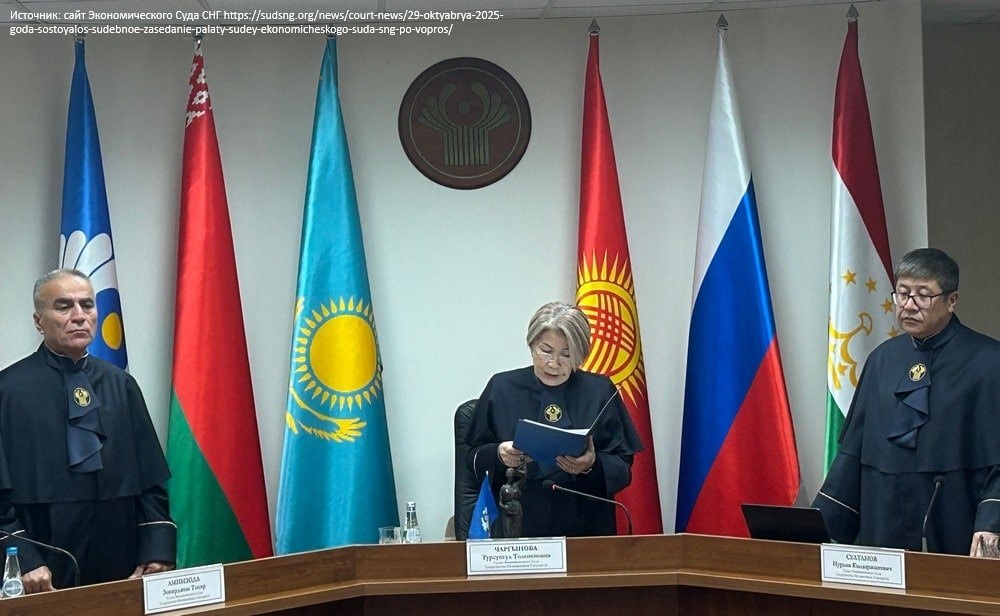
On 29 October 2025, at the premises of the Economic Court of the Commonwealth of Independent States (CIS) in Minsk, a hearing of the Chamber of Judges of the CIS Economic Court continued regarding the request of the Executive Committee of the Commonwealth of Independent States to clarify paragraph 4 of the operative part of Advisory Opinion No. 01-1/2-02 of 10 September 2002 rendered by the CIS Economic Court.
The Chamber of the CIS Economic Court, composed of the presiding judge T.T. Chargynova (Kyrgyz Republic), the reporting judge N.K. Sultanov (Republic of Kazakhstan), and judge Z.T. Aminzoda (Republic of Tajikistan), with A.V. Ravich serving as the session secretary, conducted an open hearing using oral procedure.
The Chamber examined the request of the CIS Executive Committee for clarification of paragraph 4 of the operative part of Advisory Opinion No. 01-1/2-02 of 10 September 2002 on the interpretation of paragraph 9 of the Rules for Determining the Country of Origin of Goods of 24 September 1993, as amended by the decision of the CIS Council of Heads of Government of 18 October 1996, and issued the corresponding ruling.
The Legal Nature of Tariff Preferences in the Relations of States Parties to the 1994 Free Trade Area Agreement: Analysis of the Clarification of the CIS Economic Court of 29 October 2025
The clarification adopted by the CIS Economic Court on 29 October 2025 constitutes a significant act of official interpretation of international treaties governing the free trade regime within the Commonwealth of Independent States. The clarification was adopted in response to a request from the CIS Executive Committee, which asked the Court to determine the legal nature and implications of the participation of a third party—a non-resident of the States Parties to the 1994 Agreement on the Establishment of a Free Trade Area—in a commercial transaction involving the supply of goods originating from Turkmenistan.
The issue arose from a specific customs situation in which a resident of the Republic of Belarus imported goods entirely produced in Turkmenistan, while the contract stipulated that payment would be made to a Polish company that was neither the seller, nor the buyer, nor the owner of the goods. The Belarusian customs authority questioned the lawfulness of applying tariff preferences under the 1994 Agreement where the financial obligation in the transaction was addressed to a legal entity that is a non-resident of CIS member states.
The Economic Court constructed its interpretation by relying on the provisions of the 1969 Vienna Convention on the Law of Treaties, which establishes general rules for treaty interpretation, including the need to consider the context, object and purpose of an agreement, as well as subsequent practice regarding its application. The Court also invoked Articles 26, 30, and 34 of the Convention, which govern the principle of good-faith performance of international obligations, the relationship between successive treaties, and the prohibition on imposing obligations upon third states. A key element of the analysis was clarifying the legal status of the 1993 Rules for Determining the Country of Origin of Goods, which were incorporated into the 1994 Agreement and form its treaty-legal foundation. The Court confirmed that this normative framework continues to apply in the relations of those states that have not acceded to the later instruments—the 2009 Agreement and the 2011 Free Trade Area Treaty.
Special attention was given to the status of Turkmenistan. Although Turkmenistan signed but did not ratify the 1994 Agreement, it has applied its provisions on a provisional basis for an extended period. Other CIS states did not object to this practice, which the Court construed as a form of tacit consent that effectively transforms provisional application into a sustained practice with legal significance. On this basis, the Economic Court affirmed that the 1994 Agreement continues to regulate trade-economic relations between Turkmenistan and those CIS states that have not joined the later agreements. This conclusion was grounded in the interaction of Articles 26 and 30 of the Vienna Convention, according to which later treaties supersede earlier ones only in the relations of the states party to both instruments. Since Turkmenistan did not sign the later treaties, it remains within the regulatory scope of the 1994 Agreement and the 1993 Rules.
The principal legal question before the Court concerned whether the fact that the buyer paid monetary funds to a third party that is not a CIS resident affects the possibility of applying tariff preferences. The Economic Court held that this factor does not affect the criteria of origin, is not regulated by the 1993 Rules, and does not belong to the circumstances that have legal significance for determining the free trade regime. The right to tariff preferences is linked exclusively to the fulfilment of the conditions on the origin of goods, the identity of the parties to the contract, and the direction of supply. Neither a direct commercial connection between the producer and the importer nor the involvement of a third party in the chain of payment execution is required. The Court emphasised that private international law, including the UNIDROIT Principles of International Commercial Contracts and model instruments on the assignment of receivables, allows extensive use of intermediated and secured payment structures, including assignment of claims, factoring, and agency arrangements. These legal forms are neutral with respect to customs regimes, as they do not alter the origin of goods or the status of participants in a foreign trade operation.
Accordingly, the Court concluded that the involvement of a third party that is neither a party to the contract of sale nor a participant in the circulation of the goods does not impede the application of tariff preferences under the 1994 Agreement. Such involvement does not affect the determination of country of origin and does not undermine the objectives of the free trade regime. The crucial conditions remain that the seller and the buyer must be residents of states that are parties to the 1994 Agreement, and that the goods must be produced in and exported from the territory of the relevant state in accordance with the 1993 Rules.
At the same time, the Economic Court limited the scope of its clarification to the application of the 1994 Agreement. In the relations of states that have transitioned to the legal regime of the 2009 Agreement or the 2011 Treaty, the clarification is not applicable, as the normative bases for tariff preferences and the determination of origin in those instruments differ. The Court advised the Executive Committee to submit a separate request for interpretation concerning the 2009 Rules, which govern these issues within the updated free trade area.
The legal significance of this clarification lies in its systematisation and refinement of the rules on the conflict of treaties within the CIS and in its reaffirmation that commercial mechanisms for allocating payments do not affect the criteria for granting tariff preferences. The clarification also demonstrates the Court’s consistent reliance on the Vienna Convention and contributes to forming a certain “precedential” practice in the interpretation of CIS international treaties, which is of considerable importance for law-application in the member states.
Additional information is available at: https://sudsng.org/news/court-news/29-oktyabrya-2025-goda-sostoyalos-sudebnoe-zasedanie-palaty-sudey-ekonomicheskogo-suda-sng-po-vopros/